Last verified: 20 November 2026
This page tracks the duties and trade measures that apply to Indian ceramic tile in its main export markets, plus the duty on tile coming into India. Seven jurisdictions in all: the United States, the European Union, Vietnam, the Gulf states, the United Kingdom, Taiwan, and India inbound.
It is a register of instruments, not a duty calculator. The difference matters, so here it is plainly. A register tells you that a measure exists, who issued it, which document it sits in, what that document says, and when we last looked. A calculator tells you that your rate is a particular number. We do the first and not the second, because the duty on a specific shipment depends on how that shipment is classified, which company shipped it, when it was entered, and a handful of other things we cannot see from here.
So every row below names the issuing authority, the decision or instrument number where we have it, the decision date, and its own last-verified date. Rows go stale at different speeds, which is why one date at the top of the page would not be enough. Two of the seven markets carry things we have not been able to confirm, and we say so in each case rather than fill the gap with a figure that looks right.
Before you quote a buyer, confirm the rate with your CHA or customs broker. They can see the entry, the classification and the company, and we cannot.
This page changes when a measure changes, not on a schedule. Subscribe and we’ll email you when we log a change to a row - what moved, which instrument, and what it does to a quote, along with our wider coverage of the tile and ceramic trade.
Subscribe to our newsletterThe terms we use, and what each one means
Six different states get collapsed into “there is a duty” in most trade conversation, and the difference between them is the difference between a quote that holds and one that does not. These are the only ones we use, and we would rather add a term than stretch one of these to cover something it does not fit.
| Term | What it means |
|---|---|
| In force | The measure is live, we have checked the instrument, and the rate applies today |
| In force, under review | Live, but a sunset or expiry review is running that could change it or end it |
| Lapsed pending decision | The original term has expired, a review was started before it expired, and the outcome has not been published |
| Initiated | An investigation is open and there is no duty yet |
| Closed negative | The investigation finished and no measure was imposed |
| Reported extended, primary instrument pending | A trade-measures record reports that a measure has been extended, but we have not obtained and read the issuing authority’s own decision |
Two rows do not use one of these terms, and it is worth saying why rather than forcing them to fit. The United Kingdom row is not a trade remedy at all but a tariff commitment under a trade agreement, so its status describes that instead. Taiwan’s reads as a plain statement of what is known and what is not, because the one thing a status term would have to assert there is the thing we cannot establish.
The register at a glance
| Market | Measure | Authority | Instrument | Decision date | Status | Last verified |
|---|---|---|---|---|---|---|
| United States | Countervailing duty | US Department of Commerce | Order, FR Doc 2025-11052; determination at 90 FR 17036 | 16 Jun 2025 | In force | 20 Nov 2026 |
| United States | Antidumping | US Department of Commerce | Final negative determination, 90 FR 17030 | 23 Apr 2025 | Closed negative | 20 Nov 2026 |
| United States | Section 301 tariff, forced-labour enforcement action | USTR, on presidential direction | Notice of action, 91 FR 47318, published 28 Jul 2026; US note 52(a) | 23 Jul 2026, presidential direction | In force | 20 Nov 2026 |
| European Union | Antidumping | European Commission | Regulation 2023/265, as amended | 9 Feb 2023 | In force | 20 Nov 2026 |
| Vietnam | Antidumping, effective 22 Sep 2026, five-year term | Ministry of Industry and Trade | Decision 2174/QD-BCT, case AD23 | 7 Sep 2026 | In force | 20 Nov 2026 |
| India, inbound from China | Antidumping on specified porcelain and vitrified tile | Ministry of Finance, on DGTR recommendation | Notification 09/2022-Customs (ADD) | 24 Feb 2022 | In force | 20 Nov 2026 |
| Gulf states | Antidumping, extension terms and margin schedule not confirmed | GCC Bureau of Technical Secretariat for Anti-Injurious Practices | Extension reported, notice not obtained | 21 Apr 2026 reported | Reported extended, primary instrument pending | 20 Nov 2026 |
| United Kingdom | Tariff elimination on entry into force, Chapter 69 in staging category A | India-UK CETA, Appendix 2A-b | UK schedule of tariff commitments | 15 Jul 2026 | In force, subject to rules of origin | 20 Nov 2026 |
| Taiwan | Antidumping | Ministry of Finance | Five-year term from 4 Oct 2021 | 27 Sep 2021 | Original term expired 3 Oct 2026; continuation not confirmed | 20 Nov 2026 |
United States
This is the row that has changed most and the one that costs the most to get wrong. Three separate things now sit on a container of Indian tile landing in an American port, and they are issued by different bodies under different laws. Read together they put an Indian exporter in a materially different position from a European one, which is the part the trade has not fully absorbed.
The countervailing duty
The US Department of Commerce issued the countervailing duty order on 16 June 2025. The final determination behind it was published on 23 April 2025 at 90 FR 17036. The rates are company-specific.
| Exporter or producer | Rate |
|---|---|
| Antiqa Minerals | 3.45% |
| Win-Tel Ceramic and Theos Tiles | 3.06% |
| All others | 3.18% |
One detail on this order is unusual and worth knowing. When the International Trade Commission made its finding on 19 May 2025, it found a threat of material injury to the American industry rather than injury that had already happened. That is a less common basis for an order, and it is the reason the order applies going forward from publication rather than reaching back.
There is no antidumping order
This is the piece most often got wrong in conversation, so it is worth stating flatly. The antidumping case against Indian ceramic tile ended with a negative finding. Commerce published its final determination on 23 April 2025, at 90 FR 17030, and both of the companies it examined came out at 0.00 per cent. The petitioners had asked for margins between 328.14 and 489.36 per cent. None of that was imposed. There is no antidumping order on Indian ceramic tile in the United States, and anyone pricing against one is pricing against something that does not exist.
A warning if you go looking for that document. The two April 2025 notices sit three pages apart in the same issue of the Federal Register and are easy to swap: the negative antidumping determination is at 90 FR 17030, and the countervailing determination is at 90 FR 17036. The mix-up is not confined to the trade either. The trade commission’s own final report on this case cites the antidumping determination at both page numbers in different places. If you are checking a rate against the record, make sure you are holding the right one of the two.
The Section 301 tariff
This is the newest measure and the one that moved the landed cost. It comes from Section 301 of the Trade Act of 1974. Three dates run close together here and they are worth keeping apart: the presidential direction came on 23 July 2026, the duties took effect on 24 July, and the notice of action was published on 28 July at 91 FR 47318. The one that decides whether your entry is caught is 24 July.
Now, what this tariff is not, because the shorthand everyone uses for it invites the wrong conclusion. It is often called a forced-labour duty, and that can be read as saying the goods it hits were made with forced labour. It says nothing of the kind. The investigation looked at whether each country enforces its own ban on importing goods made with forced labour, and the tariff attaches to products of the countries found wanting. It is a tariff on an economy’s enforcement record, not a finding about any tile, any factory or any worker. If a buyer puts that reading to you, that is the answer.
You will see this filed under Section 122 in places, and there is a reason for the mix-up rather than simple carelessness. A separate 10 per cent global tariff under Section 122 expired at the very moment this one took effect, 12.01am Eastern time on 24 July 2026. Two different measures under two different laws, handing over on the same morning. Only this one is still running.
The Office of the US Trade Representative looked at 60 economies and asked whether each one enforces its own ban on importing goods made with forced labour. It found all 60 falling short on one count or both.
India sits at a flat 10 per cent, added on top of the normal duty. It is worth knowing that this was not the first proposal. The draft action published in June 2026 had India in the 12.5 per cent group. India then brought in its own prohibition on importing goods made with forced labour, and the final action moved India down to 10 per cent. The reason matters as much as the number: the rate responded to a change in Indian law, which means it is the kind of rate that can move again.
That word “flat” is doing real work. The notice runs two different mechanisms. One group, which includes India, Bangladesh, Pakistan, Indonesia, Canada, Mexico, the United Kingdom and others, gets a flat rate added to whatever the normal duty already is. A second group is treated “net of MFN”, meaning the new duty tops the total up to a set figure and adds nothing if the normal duty already reaches it. The European Union and Taiwan are in that second group at 10 per cent. Japan, Korea and Switzerland are in it at 12.5 per cent.
The measure applies to goods entered for consumption on or after 12.01am Eastern time on 24 July 2026. There was in-transit relief for goods loaded before that date and entered before 12.01am Eastern on 28 July 2026, which has now passed.
Why tile is covered
Readers have asked whether ceramic tile is caught by this at all, so here is the reasoning rather than just the conclusion.
US note 52(a) in the notice sets a general rule: the additional duty applies to everything from the listed economies except what the notice goes on to list as exempt. The exemptions are then set out in a series of subdivisions covering food and farm goods, minerals and chemicals, fertilisers, metals, civil aircraft and parts, pharmaceuticals, steel, aluminium and copper articles, vehicles and their parts, wood products, semiconductors, certain goods moving under North American and Central American trade agreements, and a set of lists that exempt particular goods for particular countries.
Two things follow. Chapter 69, which is where ceramic tile lives, does not appear in any of those subdivisions. Chapter 68 does appear, at headings 6812 and 6813, and that is a different chapter and an easy thing to misread if you are skimming. Second, thirteen economies have their own country-specific exemption lists, among them the United Kingdom, the EU member states, Switzerland, Taiwan, Indonesia and Bangladesh. India has no such list. That is the structural point: the only place an India-specific carve-out could sit is the part of the notice that holds country-specific carve-outs, and India is not in it.
Now the limits of our own reading, stated plainly. This is a very long notice and we read roughly a third of it. In what we read, India does not appear in the country-specific exemption lists, and Chapter 69 does not appear in the exempt product categories we identified. We have not audited every line of every annex. So we treat ceramic tile under heading 6907 as covered for the purposes of this tracker, on that basis rather than on a complete read, and subject to the precise tariff line and any customs exclusion that applies to a given entry. If you have found something in the annexes that cuts the other way, we want to see it.
What it adds up to
| Component | Rate | Issued by |
|---|---|---|
| Normal duty on heading 6907 | 8.5% to 10% | US tariff schedule |
| Section 301 tariff | 10%, added on top | USTR, from 24 Jul 2026 |
| Countervailing duty, all others | 3.18% | Commerce, order of 16 Jun 2025 |
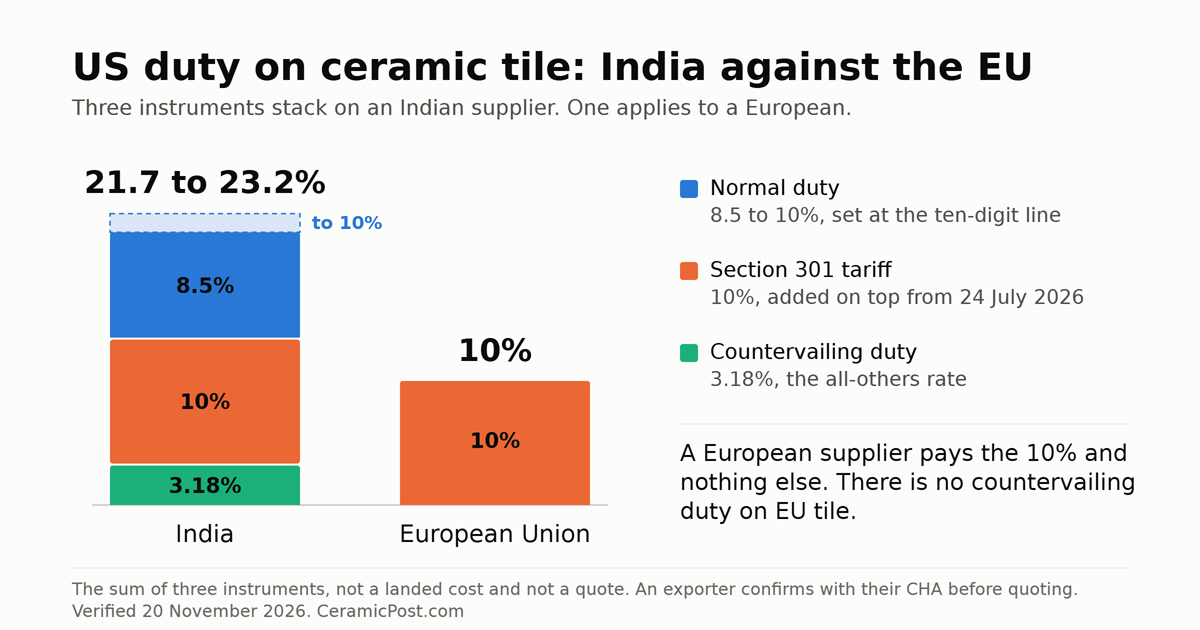
| The three added together | about 21.7% to 23.2% | Arithmetic, not a quote |
The range comes from the normal duty, which varies with how the tile is classified inside heading 6907. Treat that 8.5 to 10 per cent as a band and not a rate: the US schedule sets the normal duty at the ten-digit line, so the number that applies to your shipment depends on the full classification and not on the first four digits. An exporter with its own countervailing rate lands a little above or below the total. The whole figure is still subject to classification and to the scope of the order, which is why the line about your CHA is at the top of this page and not buried at the bottom.
Now put a European competitor next to that. An EU exporter is in the “net of MFN” group at 10 per cent, so whether its normal duty is 8.5 or 10 per cent, the forced-labour duty tops it up to 10 and no further. There is no countervailing duty on EU tile. A European supplier therefore lands at 10 per cent on the duty side, counting normal duty and Section 301 together, against roughly 21.7 to 23.2 per cent for an Indian supplier without its own rate. That is a gap of eleven to thirteen points. Before 24 July 2026 the same comparison was a gap of about three points, and the change is the single most important thing on this page.
One note on how this row moves. Both of the US measures now in force arrived within about fourteen months of each other, and the Section 301 tariff arrived with one day between the direction and the effective date. This is the fastest-moving row on the page, and the gap between a decision and an entry being dutiable can be shorter than a sailing.
European Union
The European Commission imposed antidumping duties on Indian ceramic tile through Regulation 2023/265, dated 9 February 2023, for a term of five years. The regulation has been amended and corrected several times since, so the version to read is the consolidated one rather than the original.
The duty is not a sliding scale. It is set in four bands, each tied to a TARIC additional code, and the only question that matters to a company is which code it ships under. Those bands are worth setting out properly, because the usual shorthand of “6.7 to 8.7 per cent” hides a whole category: cooperating companies listed in Annex I, at 7.3 per cent.
| Who it covers | Duty | TARIC code |
|---|---|---|
| Conor Granito and Corial Ceramic | 8.7% | C898 |
| Acecon Vitrified, Avlon Ceramic, Duracon Vitrified, Eracon Vitrified, Evershine Cera, Icon Granito, Venice Ceramics | 6.7% | C899 |
| Other cooperating companies listed in Annex I | 7.3% | Individual codes |
| All other companies | 8.7% | C999 |
The middle band is the one to notice. Companies that cooperated with the investigation without being sampled are listed in Annex I at 7.3 per cent, each with its own TARIC code, and that band is missing from almost every summary of this measure. If you are checking your own position, the code on the entry is the answer, not the group name.
One exclusion is worth knowing because it is easy to miss. Antidumping duty does not apply at all to the Lavish Group under TARIC code C903. The group is Lavish Granito, Lavish Ceramics, Lakme Vitrified, Liva Ceramics, Silk Ceramics and Luxgres Ceramica. The last two were not in the original exclusion. They were added by an amending regulation in March 2024, backdated to February 2023, after the group applied to have them included. That is why older summaries list four companies and the current position is six.
Note also how wide the EU measure is drawn. It covers CN codes 6907 21 00, 6907 22 00, 6907 23 00, 6907 30 00 and 6907 40 00, which is effectively the whole of the tile range rather than one end of it. Hold that thought for the Vietnam row below, because Vietnam did the opposite.
This row is stable and has been for nearly four years. On a five-year term from February 2023, an expiry review falls due around February 2028, though that is a date to watch rather than a guarantee. Until then the thing to check is the applied rate in the EU tariff database rather than the regulation, because that is where any change shows up first.
Vietnam
Vietnam’s Ministry of Industry and Trade issued Decision 2174/QD-BCT on 7 September 2026, closing case AD23, which had been opened on 18 August 2025. Final antidumping duties run from 5.55 to 45.30 per cent, varying by producer and exporter.
The effective date is 22 September 2026, not 7 September, and if you have been working from the English-language coverage you may have the wrong one.
Article 2 of the decision says it takes effect fifteen days after the date it was issued. The notice attached to the decision says the same thing about the duty itself. Issued 7 September, effective fifteen days later, which is 22 September 2026. The duty then runs for five years from that effective date, unless it is extended, changed or cancelled by a further decision of the Minister.
The reason this matters beyond pedantry is that several reports at the time said the duties applied from the Monday, which was the date of issue. That is the kind of error that happens when a decision date and a commencement date get treated as the same thing, and it puts a fortnight of September entries on the wrong side of the line. If you quoted or cleared anything in that window on the basis that duty was already running, it is worth a second look.
On the rates themselves, the spread is by company and the three sampled producers came out at 5.55 per cent, 22.27 per cent and 45.30 per cent. Where a company falls in that range matters far more than the headline, and a buyer comparing two Morbi suppliers may be comparing a 5.55 and a 45.30.
One practical point that has had almost no coverage here. After the decision was issued, Vietnam’s Trade Remedies Authority opened a process for applications to be exempted from the duty in case AD23. If you ship to Vietnam, that is a live route and not a theoretical one. It does not change any of the rates above and it is not a reason to treat the measure as unsettled: it is a separate application, decided case by case, and until one is granted the duty applies as published.
The detail that matters more than the rate
Here is the part worth slowing down on, because it has not been said anywhere in the coverage we have read.
The decision lists eight tariff codes: 6907.21.21, 6907.21.22, 6907.21.23, 6907.21.24, 6907.21.91, 6907.21.92, 6907.21.93 and 6907.21.94. Every one of them sits under 6907.21. That subheading is defined by water absorption of 0.5 per cent or less, which in plain terms means the dense, low-porosity body: porcelain and vitrified tile. In Morbi language, glazed vitrified tile and polished vitrified tile, the products usually shortened to GVT and PVT.
So Vietnam has not put a duty on the 6907 range. It has taken one slice of it. Heading 6907 holds three tile subheadings that are separated by water absorption and nothing else, alongside two others for mosaic cubes and finishing ceramics. The three are 6907.21 at 0.5 per cent or less, 6907.22 above 0.5 and up to 10 per cent, and 6907.23 above 10 per cent. Vietnam took the first of those three and left the rest alone.
That needs reading carefully, because it turns very easily into the wrong rule of thumb. The line is drawn on the body, not on where the tile ends up. Heading 6907 covers wall tile at every absorption band, so a dense wall tile at 0.5 per cent or less sits in 6907.21 and is inside this measure. What falls outside is anything above the 0.5 threshold, which in practice is most wall tile and the more porous floor bodies. But “wall tile” is not the test, and treating it as the test is how a consignment gets quoted wrong.
For a cluster whose export growth has been built heavily on GVT and PVT, this is still a targeted measure rather than a broad one, and it reads very differently depending on what you actually ship. Those two labels are trade shorthand for the products caught, though, not the legal definition of what is in scope.
The scope description from the investigation points the same way. It covers ceramic and porcelain tile with water absorption not exceeding 0.5 per cent by weight, made from clay and other inorganic materials and fired at high temperature, and it leaves out paving tile falling under heading 69.04.
One qualification, and it is the Ministry’s own. MOIT states that whether a product falls in scope depends on its actual characteristics and not on the tariff code alone. So treat GVT and PVT as a useful shorthand for what has been targeted, not as a legal test. The code list tells you where to look. It does not settle the question for a given consignment.
United Kingdom
This row moves in the exporter’s favour, which makes it the odd one out on this page.
The India-UK Comprehensive Economic and Trade Agreement was signed on 24 July 2025 and entered into force on 15 July 2026, confirmed by the Press Information Bureau. The tariff commitments sit in the agreement’s own annex, and the United Kingdom’s schedule is the appendix to look at.
That schedule works by staging category. Each category is a timetable: some duties come off immediately, others in equal annual instalments over five, seven or ten years. The UK schedule puts Chapter 69, ceramic products, in category A, and category A means the customs duty is eliminated on the day the agreement enters into force. No staging, no instalments.
So on the face of the agreement, UK customs duty on originating Indian ceramic products went to zero on 15 July 2026. Two qualifications, and both are real.
The first is rules of origin. The preference is for originating goods, and it is not automatic just because a container left an Indian port. The goods have to meet the agreement’s origin rules and the claim has to be made properly at entry. An exporter who cannot satisfy origin pays the normal rate, agreement or no agreement.
The second is that the commitment we have read is at chapter level. That covers heading 6907, since 6907 is inside Chapter 69, but we have not separately confirmed the applied line for a specific commodity code on the UK tariff service. For a quote we would want that check done against the exact code being shipped.
What we can say, and this is the useful part, is that the two things circulating in the trade are both wrong. It is not a staged reduction over several years, and the UK’s previous rate was not anywhere near 28 per cent.
India, for tile coming in
This page is for the Indian trade, so the duty protecting the home market belongs in it.
The duty here is narrower than it is usually described, so it is worth getting right. It is not a duty on Chinese ceramic tile in general. Notification 09/2022-Customs (ADD), issued by the Ministry of Finance on 24 February 2022 on the recommendation of the DGTR, covers glazed and unglazed porcelain and vitrified tile in polished or unpolished finish with water absorption below 3 per cent, falling under headings 6907 and 6914. In cluster terms that is the soluble salt, double charge, GVT and PGVT range. The duty is USD 1.87 per square metre.
Worth noting how the notification is built, because “from China” is looser than what it actually says. The table runs country of origin and country of export as two separate columns, which is the standard way these are drawn so that goods cannot escape a duty simply by being shipped through a third place. The practical consequence is that the country a consignment was dispatched from does not settle the question on its own. Both columns have to be read against the entry, and on a transhipped load that is where the answer usually turns.
Three things sit outside it. Micro-crystal tile, full body tile and thin panels under 5 mm are not covered. For the subject goods of Chinese origin, the notification gives a nil rate where the producer is Foshan Chancheng Jinyi Ceramics or Xin Xing Zhisheng Ceramics, rather than the USD 1.87. The producer name alone does not settle it, though: the origin and export-country conditions in the table still have to be met. And the term runs five years from publication in the Official Gazette, which puts expiry in February 2027.
Put the thresholds side by side and something interesting falls out. India protects its own market on a 3 per cent water absorption line. Vietnam has gone after Indian exports on a 0.5 per cent line. The same cluster is on opposite sides of two measures built on the same idea, drawn tighter in the market we sell into than in the market we defend.
That expiry is worth a diary entry. A duty that has shaped the domestic market for years comes up for decision inside the next fifteen months, and if it lapses the competitive picture at home changes at the same moment several export markets are getting harder. We will track the review here when it opens.
Two markets where we will not give you a number yet
These two rows are deliberately incomplete. In each case we can tell you that a measure exists, who issued it and when, and in each case there is one specific thing we have not been able to confirm from a primary document. We would rather publish the gap than publish a figure that turns out to be last year’s.
The Gulf states
Start with a correction, because this is the one most likely to be costing someone money right now. There is a belief in parts of the Indian trade that the Gulf antidumping duty on ceramic tile was removed in 2022. We have found nothing supporting that, and the trade-measures record we have been able to reach points the other way, reporting that the measure went through a sunset review and was extended. So do not quote a Gulf buyer on the assumption that the duty lapsed in 2022.
We put that as “reported extended” rather than confirmed, and the distinction is deliberate. What we have read is a trade-measures record, not the issuing authority’s own decision. So do not assume the duty has gone, and equally do not take a rate from this page, because there isn’t one. Confirm the current position and your own company’s rate with your customs broker before you quote.
The earlier history is on firmer ground. The investigation was opened on 5 November 2018, and a definitive antidumping duty was imposed and came into force on 6 June 2020. The issuing body is the GCC Bureau of Technical Secretariat for Anti-Injurious Practices in International Trade.
The recent part is where the evidence thins. A sunset review was opened in March 2025, and a trade-measures record reports an extension carrying a notice date of 21 April 2026. A second account reports the extension running for five years from 28 May 2026, which would take it to 2031. Those two are not necessarily in conflict, since one may be the notice date and the other the date the extension took effect, but we have not obtained the issuing authority’s own decision and cannot say which is which. Both are reported rather than confirmed, and we are showing you both instead of picking one.
That record carries no decision number, no end date and no company rates, which is why the extension sits on this page as reported rather than verified.
What we have not confirmed, and will not publish until we do: the company-specific margin schedule now in effect. There is a range circulating in the trade, quoted as a percentage of CIF value. That is the schedule from 2020, and the sunset review appears to have amended company margins. We checked whether this was a stale figure nobody repeats any more, and it is not. It was still being published as the current position as recently as last month. If the margins were amended, an exporter looking up its own company against that range finds a number that is wrong in the most expensive possible way, and prices a Gulf order against it. We are not going to be the publication that repeats it. We also do not have the effective date of the extension or its end date on a primary instrument, though both are in circulation.
We are working on this through the measure’s Arabic-language text and through the Morbi Ceramic Association, which holds a translated copy.
Taiwan
Nobody in the Indian trade press appears to have been following this one, including us until recently. It is in the register now.
Taiwan’s Ministry of Finance imposed antidumping duties on ceramic tile on 27 September 2021, in force from 4 October 2021, for a five-year term. That term ran to 3 October 2026. The rate set for India was 20.07 per cent, with three Indian suppliers exempted. A sunset review was announced on 18 September 2026, covering India, Vietnam, Malaysia and Indonesia. The Customs Administration of the Ministry of Finance runs the investigation, the Ministry of Economic Affairs assesses injury, and the Customs Tariff Rate Commission makes the ruling.
One aside on reading about this. At least one headline describes the review as covering four Southeast Asian countries. India is in scope and India is not in Southeast Asia, so if you searched for this and concluded it did not concern you, search again.
The thing we cannot tell you is whether the duty is being collected today. Taiwan’s rules say a duty ends no later than five years after it was imposed unless a sunset review is started and the Ministry decides to keep it. They do not spell out what happens in the gap between the term expiring and the decision arriving. The review was announced about two weeks before expiry, and the investigation can take six to ten months. So Taiwan is either in force at 20.07 per cent or lapsed pending decision, and we are not going to guess which. If you have a live Taiwanese order, your CHA can tell you what is actually being collected at the border, which is the only answer that matters.
How we keep this current
A tracker is only worth the checking behind it, so here is the checking.
Each row is checked against a named source. For the United States that is the Federal Register, covering notices from both USTR and the trade administration, plus the Commerce list of antidumping and countervailing proceedings. For the European Union it is the Official Journal and the applied-rate database. For the United Kingdom it is the trade tariff service notices. For the Gulf it is the GCC Bureau, whose own decision we have not yet obtained, which is why that row currently rests on a secondary trade-measures record rather than on the instrument itself. For Vietnam it is the trade remedies section of MOIT. For Taiwan it is the Ministry of Finance, with the Ministry of Economic Affairs for the injury side. For India inbound it is the customs notifications of the Ministry of Finance, which is the authority that imposes the duty, with DGTR for the investigation and the recommendation behind it.
An honest word about frequency. Three of those seven publish the material that matters in Arabic, Vietnamese or Mandarin. A quick scan of English trade coverage is not a check on them, and we know that because it is exactly how the Gulf extension reached us five months late and how Taiwan did not reach us at all. So we are running the United States, the European Union and the United Kingdom as actively monitored rows, and carrying the other four as last-verified entries with the date shown. For three of those four the obstacle is language. For India inbound it is not: the material is in English and the next thing to watch is simply the February 2027 expiry.
We log the check whether or not anything moved. A line saying we looked on a given date and nothing had changed is the point of a register. A page that only gets touched when something happens is indistinguishable from a page nobody is reading.
Reading this alongside the volumes
Duties tell you what a market costs to enter. They do not tell you whether anyone is still shipping. For that, our monthly export data carries the volume and value series by destination, and the two pages are more useful read together than apart. A duty that went up in July and a destination whose volumes held anyway is a different story from one where they did not.
If you have a document any of the unconfirmed rows is waiting on, we would like to see it. The two we most want are the current Gulf margin schedule and anything showing what Taiwan is actually collecting today. A clearing document, a CHA’s assessment, a translated notice: any of those would close a row.
And you will see it land. When something arrives that settles a row, the status changes, the last-verified date on that row moves, and the next person to read this page gets the answer instead of the gap. That is the whole point of maintaining it this way rather than writing it once.